Saturday, April 24, 2010

Ambush At Jones Crossing

North bank of Jones crossing

Saddle reportedly belonged to one of the assassins

A Time to Remember
Ambush at Jones Crossing
By Ronnie Powell
The following story is true, but is my interpretation of the event, based on eye witness accounts some of which in my opinion were not duly noted and are inconsistent with an article published in a newspaper in 1882. I have changed the names of the characters in this infamous tale rendering it fiction, adding additional points of view not found in the old newspaper clipping.
In the early evening of May 25, 1882 two men were brutally slain in the North-East portion of Dallas County, near Windyville, Missouri. Two other men were wounded. The crime took place along a road near Jones Crossing, between the Harvey and Williams farms about two hundred yards from the Harvey and a half a mile from the Williams farm. Matt Williams one of the wounded in the fracas resided on the Williams place.
The ambush site a brush thicket near the road was carefully prepared. Holes were cut in the brush upstream for a commanding view of the crossing. At least two of the assassins were armed with shotguns and lay waiting for the arrival of their victims. A third man stood picket behind a tree several feet away to alert the other men hiding in the brush and then would quickly join them.
In the meantime Gerald Matson, twenty six and C.R. Matson eighteen, (brothers) one riding a mule and the other a horse were heading home and stopped to pick up two boys, (some say forced them to ride along). John Shantz seventeen and Matt Williams sixteen were about a half a mile from the river crossing where the shooting would allegedly take place.
The arrival of the four victims was detected at about fifty yards from the river crossing in the dusky light of mid-evening with each of the murderers laying in wait. The shooting commenced at a very short range, killing C.R. Matson instantly, wounding Gerald Matson and Matt Williams along with John Shantz. The horse and mule were also killed. Gerald Matson attempted to flee back up the road, but was shot dead by another blast from a shotgun and the shooting stopped abruptly.
Only one of the shooters was observed running from the scene. According to Matt Williams, a man of approximately five feet eight of ordinary build wearing a ragged coat of drab color fled into the brush. The young man stated he did not know the fellow.

Gerald Matson’s wounds consisted of thirty buckshot wounds in his back and left side above the hip. Twenty seven buckshot wounds were found in the left side of C.R Matson one cutting the left common carotid artery and three shots penetrating the heart severing an artery.
Matt Williams received five flesh wounds, three in the thigh and two in the arm. John Shantz received two flesh wounds, one in the leg and one in the arm. Neither boy’s wounds were life threatening and both recovered.
Under oath both boys recounted the events leading up to and during the ambush. Their testimony revealed that Matt Williams met up with John Shantz with intentions to fish in the river. They came upon the two Matson’s and Melvin Harris, Jim Frank and two women and two children near the river. Gerald sat astride a horse and C.R. a mule. Gerald was quarreling with Jim Frank, threatening to forcibly take money owed him from the group.
The Matson’s, Harris, and Frank left along with the women and children. Matt and John remained near the river and began digging for worms and upon the return of the Matson’s; they asked told to ride with them. Matt climbed up behind C.R. and John behind Gerald. Gerald and C.R. were drinking. They rode down into a hollow along the county road and again approached the crossing and were fired upon from buckeye brush. Smoke and the crack of a gun could be seen and heard coming from the brush. Gerald and John were the first to arrive and were the first hit. About a minute later Matt and C.R. were also shot.
The Justice of Peace and acting coroner impaneled a jury and after viewing the bodies and hearing the evidence, submitted a verdict that the deceased Gerald and C.R. Matson died by gunshot wounds inflicted by parties unknown.
Many of the local people believed there were at least seven men involved in the killing of the Matson’s in retribution of not unlawful acts by the young Matson’s prior to the shooting, but rather by unjustified personal retaliation. On February 9th Jim Frank and three other men were charged and held for a preliminary hearing in the assassination of Gerald and C.R Matson. The hearing lasted two days with many witnesses coming forward and a verdict was in favor of the State. A trial date was set for the next term of circuit court. The defendants bonds were set at one thousand dollars each and were released. Jim Frank alone was ultimately charged with being an accessory to the killings. There are no records stating that any of the men were ever actually convicted.


Matt Williams sometime later fell into a hog pen and was attacked by hogs. The wounds resulted in his death. One account of the shooting at the river states that Gerald returned fire with a shotgun he carried. Nearly a hundred years later at an estate auction a saddle allegedly belonging to one of the assassins sold for fifty dollars and is at present in my possession. The river crossing where the shooting supposedly took place is now part of an old abandoned county road where even at the present the vintage road snakes down through a hollow to the ford where buckeye brush still flourishes affording a commanding view of the ambush site where the shooters lay in waiting. Adios.

Sunday, April 18, 2010

What Error To Gain A Biscuit?


This story is in its original notation, but is in story form in the book, Life Along The Dousinberry
What Error to Gain a Biscuit?
By Ronnie Powell
On an especially warm day in late spring of 1947, my twin brother Donnie and I stood waiting for Dad to finish hitching our team of horses to a cultivator. The sun was barely over the horizon and we were facing a rather long day in the cornfield replanting corn, a kernel at a time. Our overall pockets bulged with these precious kernels. The process would take us down each row to stop and drop a kernel where needed, cover it with a hoe and then move on. The sun would be hot, the horseflies and sweat bees were most aggravating. I did not relish the thought of being in the field with nothing to eat, for noon lay beyond my comprehension. I glanced at Dad appearing totally absorbed in the hitching and handed my hoe to Donnie and sprinted away toward the house.
I estimated the journey to the house and taking possession of several left over breakfast biscuits to take no more than a couple of minutes and was certain Dad would be unaware of my absents. How very wrong I would be.
I rounded a rear corner of the house, glimpsed Mother at the well drawing wash water and headed for the backs steps. Never breaking stride I took the first step up stumbled and fell striking my neck across one of the rough oak planks and the journey ended abruptly and with dire consequences. I struggled to breath, slipping close to the brink of unconsciousness. I rolled off the steps gasping and croaking like a frog. I continued thrashing about on the ground vaguely aware of Mother’s hysterical screams. It would be several hours later before I regained consciousness.
Doctor Plummer was the first face I saw, a kind old man in a rumpled suit who had helped bring me into this world. I was struck by the grimness of his face, flinching at the probing hand on my neck. I attempted to smile, but could not and then tried to speak, but failed to do so and once again moved quietly into blissful oblivion.
The good doctor of Buffalo, Missouri informed my parents I had received a crushing blow to my larynx, but couldn’t be certain of the extent of damage. Doctor Plummer informed them I would probably be unable to make a sound for awhile if ever and advised the distraught couple I should be placed in a hospital for further examination, fully aware they had no money for such a stay.
I awakened early the next morning on the davenport in the parlor. I caught the dawning sun glinting from Mother’s prized cut glass vase sitting on a table near the front window. I then recalled the day before and sat up, feeling remarkably fit except for a deep soreness in my throat. I took notice that I was clothed in one of Mother’s old flannel night gowns and became quite angry. I looked about the room for my clothing and saw the shirt and overalls lying in a heap near the door. Intent on getting out of the gown I tried standing but too weak slid to the floor and began crawling toward the garments. I could barely hold my head up, saliva drooled from my mouth making the floor slippery. The pain was near unbearable, but I continued on to the clothing. I quickly shed the gown, got into the shirt and overalls and crawled back to the couch hissing like a snake. I had at least restored my dignity.
A little later that morning the entire family entered the room. Both of my brothers stood at the door. Dad, Mother and Grandma Carrie came to the couch. Not one to mince words, Dad quietly informed me I had severely injured my voice box, as he called it and would be a spell before I could talk aloud again and perhaps never. Mother stood looking down at me weeping. Grandma also wept, holding a steaming bowl of her chicken noodle soup.
I did not take well to the disturbing news, but nodded, peeking under the covers to see if Mother had again put the gown on me, but she had not. Grandma coaxed me into eating the soup and I did so without too much difficulty and later was accompanied to the outhouse, where I set for a time idly looking through the pages of a Sears, Roebuck catalog reflecting on my dilemma.
Resilience is the definition of youth and in a couple of days I was again back on my feet resuming my chores. I could not imagine ever speaking aloud again. The thought of being a mute haunted me and in the following days, weeks and months I began realizing what I was up against. My brothers of course teased me and a few adults treated me shamefully as if I did not have good sense. One of the local ministers came by one day to see me and began shouting as if I were deaf. He then asked Dad if I was mentally challenged. The man was told to leave.
Grandma Carrie encouraged me to write on paper as clearly as I could to answer any questions presented to me and to try and communicate with people. I took advantage of every idle moment slipping off alone in the woods to try and make a sound, but September came and school. It did take long to discover that my peers including the teacher were understanding and did their best to put me at ease. It was not the children, but the few adults I came in contact with that depressed me the most with their I suppose good intentions and thoughtless behaviors. Yet during the long silent months I never lost faith that I would speak aloud again.
In early spring of the following year while walking along the old Brushy Ridge road, trying in earnest to make a sound, I uttered a guttural word or two, yet they were music to my ears. From that day on I began to speak aloud again, at first a raspy whisper and gradually a more normal vocalization. There are times even today my voice fades but for the most part has served me well. I came away from that dreadful experience a bit too independent I suppose and a deep appreciation for folks who have been handicapped. Life comes in many flavors and colors and to survive one must not judge people by a bad taste or gray reflection that does not represent the soul of a fellow human. Adios

Thursday, April 15, 2010

A Time For Beautiful Heidi

Beautiful Heidi

Time for a treat


Heidi finds a cricket


Heidi on point

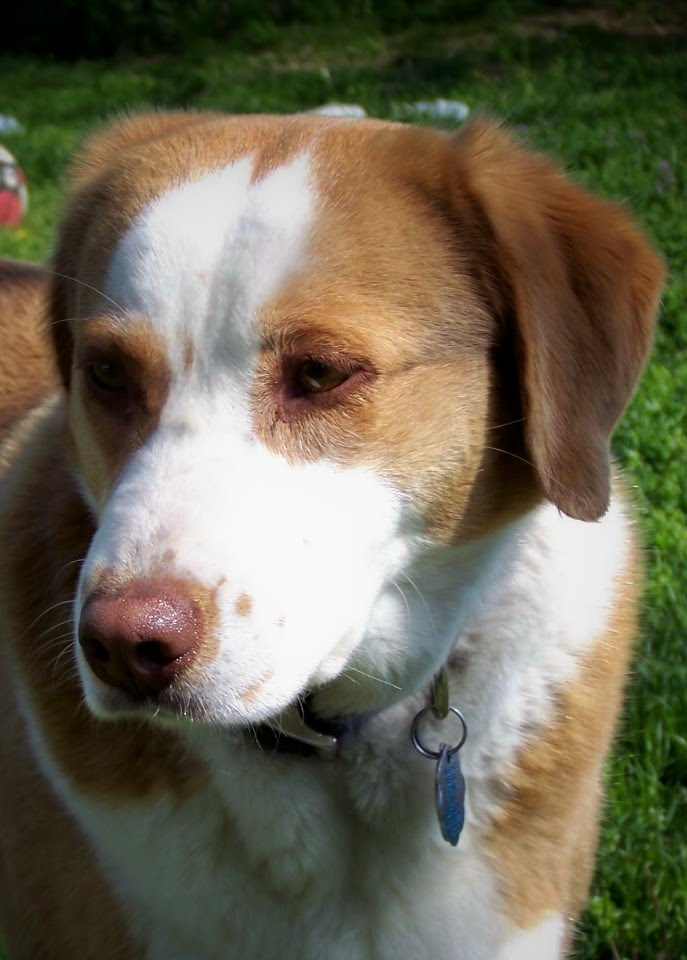
At this writing Heidi is well and more beautiful than ever. She and I are close companions and we have endured the long winter months, where every evening she and I would sit for a time in her cabin with the door closed. Often the wind blew wet and cold outside and after sharing little peanut butter sandwiches with me she would snuggle down beside me and sleep. One of my old winter shirts after being warmed by the stove inside my house covered her. There she would remain until she sat up as if to say it is time for me to leave. Of course she knew I had a treat to give her. She likes to shake hands with me and often licks my face or hand. She is very protective, perhaps a little too much. Heidi welcomes the time when I arrive to go in her cabin and seems relieved to be locked inside for the night. There are still signs of her experience of being mistreated. She does not trust very many people and often reverts back to cowering, even from me. But time is slowly dimming those memories. She loves to play ball, but as yet will not bring it to me. She cries when I leave and sits and watches when I am in sight of her. She trusts my wife and comes to her most of the time. Sadly she will not enter her cabin during a storm unless I tell her to and will and has remained outside drenched to the skin. But I am patient and know that I will see the day when she is completely at ease with her world and mine. Adios

Monday, April 12, 2010

Beware Wild Beauties

At last they have arrived to share the summer with me

I have returned once again to Barefoot Pass. My new book demanded my attention and I have been very busy mailing them out and hosting those faithful readers who came to take possession of Life Along The Dousinberry. The book is selling well and I am deeply appreciative of the response. They have and are traveling far and wide to people to read. All my books except the first one, South Through Barefoot Pass is numbered, but all are signed and dated. My new book has been compared to the writings of Booth Tarkington, author of Penrod and Sam and many others. I am flattered by such a comparison. Life Along The Dousinberry is the story of an Ozark boy growing up in the troubling years of the 1940's. All my books are without profanity and other lurid aspects. For more info go to rdpowell@hotmail.com.


Beware Wild Beauties
Soon now as spring gains the upper hand the lawns of most homes will flourish. The majority will be carefully groomed and will be void of wild flowers, (Weeds) representing the intended perfection of the owners. Chemical warfare will be in full force, eliminating anything that threatens to trespass these sacred grounds. For some there is no tolerance and anything of nature’s wild beauties will perish. This sounds ominous, but it is the right of the owners to display their taste in groomed lawns. The lowly Dandelion has been the victim of mass extermination for many years, systematically destroyed as if it is a plague, but in truth it is one of the most beautiful, delicate and enduring creation on this Earth. It is also edible containing healthy nutrients in salads and tea and wine. To eliminate all Dandelions from the face of this planet would be a tragedy, nothing less. Never again would a child pluck one that has gone to seed and make a wish before blowing the seeds into the wind. To never stand at the edge of a field and see the Dandelion in bloom and watch the bees buzzing around is an awful thing to comprehend. It is doubtful and more of a certainty I believe the dandelion will never perish, for it has a way of slipping in among the hierarchy of grass, snuggling down and then rises to shine like the sun as it was meant to be. When at last the first Dandelion appears on my lawn I will welcome this delicate bloom for it has a place on my lawn, but it must hunker down on mowing day. If indeed the Dandelion is a weed, than I am kin. Adios.

Saturday, March 27, 2010

A Question


Was it a breeze that touched my face, tugged at my sleeve and then was gone?
It was a fleeting thing, leaving the Black Eyed Susan’s nodding in the dawn.
Was it a breeze that caused the cedars to whisper to the Whippoorwill?
A gentle passing stirring the oaks high on a barren hill.
Was it a breeze, or perhaps an old friend that passed by and touched my face, I wonder? Adios

Friday, March 26, 2010

A Long Road Home


A Long Road Home
By Ronnie Powell

Destiny, as is fate are colorful words, romantic I suppose and used to spice up a story, statement or article. I cannot say I believe them to be the controlling factor in my life, but of course I could be wrong. Prevailing circumstances should not be overlooked that may bring about a course change in ones life and could possibly have been avoided if not for tunnel vision. To step off a curb into traffic and hit by a car some would say was fate or destiny, but on the other hand failure to look to the left and right before stepping onto the street is as far as I am concerned could be a prevailing factor. I do believe, however, to avert all negative situations would be near to impossible.
This story (true) began unwittingly with a phone call one evening on October 18, 1991. The caller was my wife’s oldest sister Belva. She needed help in moving from Texarkana. She had sold her home and was coming back to Missouri to live her remaining years. She was in tears, frustrated, sad and unable to cope with her decision. She was leaving behind many friends and a lifetime of memories. She had not thought far enough ahead to where she would live upon reaching the Ozarks. She would have a truck load of possessions that would eventually arrive. It was understandably a very traumatic time in her life and she turned to family for help.
The phone call from Belva prompted my wife and me to help her and resulted in offering her a space for a Mobil home of which we went in search of. It took time to complete all of this, but the day finally arrived when the home was set up and the water and sewer connected. The Mobil home was beautiful, very spacious and cozy and at last ready for Belva. All that was left was for me to board a bus for Texarkana and help her drive back, via Little Rock, Arkansas. It was a simple plan, to be gone about three days and then a leisurely drive home across a beautiful country.
I boarded a bus in Lebanon, Missouri near sundown and found it completely full, every seat taken and I was forced to sit on the landing by the door. The aisle between the seats was cluttered with an assortment of cardboard boxes and bulging paper sacks. The travelers were a diverse lot, men, women and children crammed together, many appeared weary, especially the women. I was told by the driver my first chance to gain a seat would be at Fort Smith, Arkansas, a hundred miles or more further ahead. I placed my small duffel back at my feet, tugged my Stetson hat down over my eyes and leaned back against a rail, resigned to a long uncomfortable ride.
The bus arrived into Fort Smith very early the next morning along a shadowy, ill kept street and came to a halt before a rather shabby building that was only dimly lit on the outside. At the ticket counter I was told I would have about an hour layover. Several hours had passed since I had eaten and I decided to go to a small restaurant inside the terminal and found it crowded with impatient people trying to get a meal before leaving. There was a lot of noise and I took a seat at the counter where two weary waitresses tried to keep up with the barrage of demands. After about a half hour I was bluntly asked what I wanted and quickly gave my order for coffee, eggs and bacon. The time for my departure was approaching and I began to wonder if I would be able to stay. The food and coffee came at last about twenty minutes before my bus scheduled departure and placed before me. I was hungry, but a part of me cringed at the food, lying on a chipped old platter swimming in grease. I quickly consumed the food and even had enough time for a second cup of the thick black coffee and off I went on my second leg of the journey to Texarkana. I hurried outside, found the bus and stepped inside. To my relief I discovered it to be only about half full and quickly took a seat near the front by a window. From there to Texarkana, the population of the bus steadily declined and by the time upon reaching my destination I was the only passenger left.
As the bus slowly came to a halt I saw Belva and a friend standing in front of the building waiting for me. I wasted no time in leaving the bus, very tired and feeling slightly nauseas and attributed it to the long night. Belva was glad to see me and introduced me to the woman standing next to her. Belva led the way across a parking lot to an old Toyota, four door sedan. I politely entered the back and sat down, even wearier now and not feeling well, but I said nothing about my condition and tried to enjoy a tour of Texarkana as we made our way to Belva’s home. I was astounded by the condition of the downtown area and could see it had once been a very beautiful and stylish place. Whole sections of it stood idle, boarded up and or in near ruins. A mall we passed looked as if it had been abandoned. I was told much of the town had moved away from the center. It was to say the least a very sad plight the old section had suffered. A lot of history lay in shambles; eventually I suppose to be lost forever.
The trip to Belva’s house didn’t take long and it too was located in an old section of town and it also had suffered greatly. A wide, tree lined Front Street once graced the lawns of well kept elegant homes but now cluttered with abandoned automobiles. Most of the homes were shabby and ill kept. Belva told me later she was afraid to live there any longer. She had even been mugged once as she was going to her garage and several times someone had attempted to break into her house. All of this put me ill at ease, along with a queasy stomach and a general feeling of a worsening physical condition.
I found her house in a state of disorder with packed boxes and empties waiting to be filled. We did little that first day and later she took me out to eat. I had no appetite, but forced the food down and she took notice and I revealed my discomfort. I told her I had eaten breakfast at the bus terminal in Fort Smith and almost immediately began feeling bad.
“You should not have eaten there, Ronnie,” she stated. “I’ll stop on the way home and get you something that will make you feel better.”
That was an understatement for in the next two days, I consumed little food, almost no water and it did not matter what she gave me my condition grew worse. I could tell she was worried about me and decided put on a face of feeling better and helped her finish the packing for the moving truck fellows to load. At first I vomited, and then diarrhea set in. It was very difficult for me to keep all of that a secret from Belva. But on the third day it was time to leave. The moving van came and I assured her they would safely pack everything and bring it to her new home in Missouri. Belva wept, for the reality of leaving her home of many years and all her friends was weighing heavy on the stooped shoulders. She I went across the street to an old friend of hers and said goodbye and the lady gave Belva a sweet potato pie for us to eat along the way.
Earlier that third day we had filled the cranky little Toyota with gasoline, packed with her clothes and other personal possession that completely filled the back of the sedan. I was informed I would drive. We started out along what must have been familiar streets to Belva to a broad four lane Highway. I noticed from time to time a small puff of black smoke coming from the exhaust and asked Belva if she had serviced the car for the trip. She said she had and the fellow assured her everything was alright, even though the old car had many miles on it. I relaxed then, determined to get home before nightfall. The Toyota had a good sound as we cruised along that wide highway toward Little Rock. I don’t think I had ever felt as bad as I did that day, but relieved to be heading home I forced a good face to keep Belva at ease.
About mid afternoon we were approximately fifty miles from Little Rock and making good time and I estimated we would cross the Arkansas line into Missouri in about two hours. The traffic had picked up considerably, but most of it buzzed on around us. We began a long descent down a hill when the inkling of trouble came. An ominous shadow of black smoke suddenly appeared behind the Toyota, wagging mischievously, but then disappeared. Whether it was my condition or apprehension I felt a cold chill run up my back. A few moments later a terrible cracking noise reverberated through the car. Black smoke gushed out from under the hood and the engine clattered and belts screamed shrilly. Again a sharp cracking noise sounded, followed by a loud thud and then more smoke engulfed us trailing behind the car like a plane going down. The smoke became so dense I could see nothing but the swirling dark cloud in the rear view mirror. Cars began passing us swinging wide, blowing their horns. Quite unnerved momentarily by all the shouting and horn blowing, I hunkered down in the seat until all the traffic had passed the tortured Toyota.
Belva screamed and shouted for me to stop the car, but I refused for there was nothing out there but highway. I pushed the accelerator to the floor, and the car barely responded, but enough to gain some speed. I wanted to find an overpass road and possibly a business for us to take refuge. Soon the radiator began to blow antifreeze and water onto the windshield and still more choking smoke. I peered ahead and could make out a road leading up to an overpass and grasped the steering wheel tighter. The engine clattered horribly and then died, but our momentum carried us half way up the road and the Toyota shuttered to a halt completely engulfed in smoke. Belva immediately left the car, screaming for me to get out before I was burned alive. I did exit the car, but not as quickly as she had, for I had not the strength. The Toyota did not burn, but sat there emitting a steady but declining amount of smoke.
Belva and I slowly made our way up the hill to a service station and informed a man of our plight. He immediately got into a tow truck and pulled the Toyota up the hill to a small lot. It was during this time we decided to go on to Little Rock and take a bus home, but in order to do that we needed help. The man in charge said he would take us to the bus terminal in Little Rock for fifty dollars and the Toyota. He said he would provide us with enough plastic bags to pack her belongings in.
We arrived at the bus station in less than an hour and the man pulled his Cadillac to the curb, opened the trunk and removed all of the bags containing Belva’s things, dropped them on the sidewalk and got into the Cadillac and then drove away.
I quickly informed Belva that I should go inside the terminal to inquire about when the next bus would arrive for Springfield, Missouri.
She was understandably very distraught, standing there next to her possessions and said to me. “No I won’t stay out here alone.”
“But, I replied, “Someone may steal everything.”
It was at this moment a tall, young black man stepped forward and said. “I’ll watch your belongings Lady.”
I looked up at the man and into his steady gaze and saw there an honest man. Belva quietly observed him and nodded. “Thank you young man,” she replied.
Belva and I hurried inside and learned that a bus bound for Springfield was due at anytime and would not stay long before it continued on. We bought tickets and hurried back out side to see the bus pulling along side the curb.
The young man smiled and said. “I’ll help you load everything.
The bus driver came to where we were standing and informed us that all Belva’s things would have to in the compartment under the bus and within moments we were ready to board the vehicle. Belva wearily climbed the steps into the bus, but I turned toward the young man and offered to pay him for staying with Belva’s belongings.
“No Sir,” he calmly replied. “I just wanted to help you folks. I ain’t taking no money.”
Approximately ten minutes later the bus pulled away from the curb and to our dismay learned it would not take a northern route toward Springfield, but was heading to Fort Smith, a long way around. My nightmare intensified.
Belva sat next to me by a window and began to cry, sobbing quietly and this lasted for several moments and then it was over. The diarrhea returned to me with a vengeance and I was forced to use the onboard restroom many times during that night. The rest room was located in the rear of the bus and swayed with the motion of the vehicle and sitting on the contraption was an ordeal in itself. I grew weaker by the hour and wondered a time or two if I should inform Belva of my worsening condition and even considered asking her to have the bus driver call an ambulance, but I didn’t for she seemed to be content at last.
There were several short stops along the way and at each one Belva would go inside, buy a cup of coffee and a chicken breast. She was enjoying herself. I did have the presence of mind to drink as much Seven-Up soda as I could, to stave off dehydration, but the diarrhea persisted and then came a low grade fever.
I am not sure how long it took us to reach Fort Smith, but it was nearing dawn when the bus pulled in next to the familiar terminal. Her belongings were unloaded and I managed to take it all inside and then more or less collapsed on a bench. Belva went to the counter and she was informed we were to have a four hour layover, devastating news to her. It really didn’t matter to me any longer, I just wanted to rest.
If not for a young woman who befriended Belva I don’t think she could have survived the on going ordeal. I don’t think Belva was too fond of her, for the young woman was very out spoken and began showing Belva an album of photos that represented her life. The girl finally took notice of me and became concerned for my well being and tried in her own way to comfort me, by offering me a pillow and water to drink. It was during and nearing the long wait, I began to realize I was feeling better and was able to call my wife to tell her she would have to meet us in Springfield and gave her an approximate arrival time.
When at last our bus arrived and we went out to board it, we were told by the driver that only one seat was available and two of us would have to stay behind. The young woman stepped up and the oratory she presented to the bus driver was quite plain and colorful. She said in part,” Mister you have no idea how much these folks have suffered. The lady’s car broke down at Little Rock, the man has got food poisoning and as for me I am very pregnant. You let the lady have the seat and Ronnie and me will sit in the aisle on my box of stuff.” (Cuss words have been omitted) The driver nodded and loaded Belva’s belongs and we boarded the bus.
“Ronnie, the girl said, “you sit with your back against me and we’ll be alright.”
Sometime midmorning we arrived in Springfield and as the bus came to a halt I could see my wife standing there waiting. A most welcome sight to say the least. When I stepped down off the bus, I smiled at her, but she did not know me for a moment or so. She said later I looked terrible as did Belva. I have never been so glad to be back at home as I was that day and slept for several hours and when I awakened I felt much better. The Long Road Home tested my mettle, an ordeal I don’t wish to be subjected to again. It was an adventure I will not easily forget. Adios

Thursday, March 25, 2010

A Poem From The Heart of Joyce


In Memory of Sunrise Surprise
Born 200 years from the birth of the U. S. A.
Sunrise was a surprise
Born at sunrise 1976, June 25
Little wobbly legs and a big blaze face
A natural fox trotter
Chestnut and pretty as could be
He came to live in Windyville
At the age of two
Gentle and a one man horse
Oh how he could buck
When someone else sit astride
His master was all that could ride
Many a trails we rode with him in the lead
Commanche and Lady followed at their speed
The beautiful Sunrise Surprise
He took sick one eve at five
A long rainy night of pain he survived
The vet came and sadly said
"Sunrise is very sick."
So at 8 a.m. he left this old hill
Riding in the heavens on high
He's free from the pain and hurt
He endured in his life on Earth
Commanche, his old pal of 29 years is so sad today
As we are all that he had to go away
On December 4, 1999
Forever on Windyville hill, his memory will stay
But the beautiful Sunny will have to leave today
Joyce
A treasured poem. Adios